
Please join me for a free grain webinar every Thursday at 3pm Central. We discuss supply, demand, weather, and the charts. Sign Up Now
Commentary
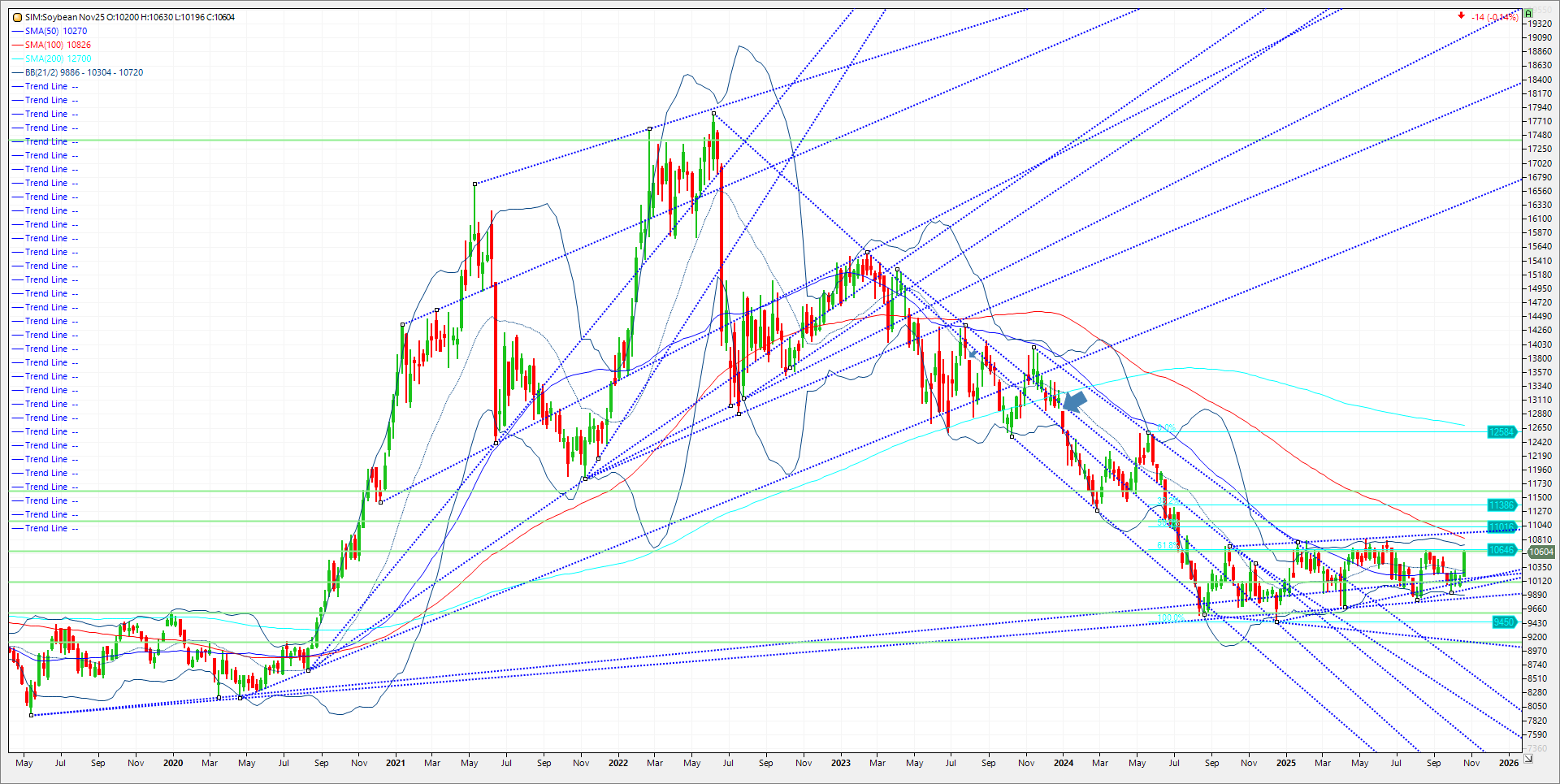
Meal futures were able to extend an impressive string of gains, which led the soy complex’s early week trade. A solid rebound in crude offered support to soybean oil, which pushed nearby soybean futures to seven-week highs. Nonetheless, uncertainty lingered as the government shutdown extended into its third week, while President Trump heaved a back-and-forth tone regarding trade with China. Optimism did improve after Trump confirmed a meeting with Chinese President Xi Jinping, set for October 30 on the sidelines of the Asia-Pacific Economic Cooperation Summit. Harvest efforts are winding down, and basis continues to improve across much of the Corn Belt. The bean has slowed a bit into the weekend but not before the spot SX5 contract posted a five-week high; the grain trade still has very little to go on fundamentally as long as the government remains shut down, with all eyes on the looming meeting between Presidents Trump and Xi in South Korea next week. Traders are assuming that the supply side of the corn and soybean balance sheets will be tightening compared to aggressive September USDA estimates in my view. Demand remains strong overall with the notable, massive exception of China’s potential absence in the U.S. soybean export market thus far in 2025/26. In either case prices aren’t staying here in my opinion. January soybeans which are now top step revisited the key resistance area in the 1060/1075 are this week. This level has been a wall of resistance for over a year on the weekly continuous chart. The takeaway in my view is that we finally blast through his wall and trade to the 10% higher on year threshold at 11.10 or fail again here and retest near term lows below 10.20. With this in mind please consider the following options strangle.
Trade Ideas
Futures-N/A
Options-Buy the December 1110 call and the December soybean 1020 put strangle for 7 cents OB.
Risk/Reward
Futures-N/A
Options-the risk is the price paid for both options which in this case is seven cents or $350 plus commissions and fees. We are looking for increased volatility ahead of US/China and the Fed next week. I see the market retreating back to where it came from a few weeks prior or making new yearly highs in November. Offer the strangle at 30 cents OB to exit for a gain of 23 cents per while using a sell stop at 3 cents good to cancel. This would risk approximately 4 cents plus trade costs and fees.
If you would like to receive more information on the commodity markets, please use the link to join our email list Sign Up Now
Sean Lusk
Vice President Commercial Hedging Division
Walsh Trading
312 957 8103
888 391 7894 toll free
312 256 0109 fax
Walsh Trading
311 S Wacker Drive Suite 540
Chicago, Il 60606
Walsh Trading, Inc. is registered as a Guaranteed Introducing Broker with the Commodity Futures Trading Commission and an NFA Member.
Futures and options trading involves substantial risk and is not suitable for all investors. Therefore, individuals should carefully consider their financial condition in deciding whether to trade. Option traders should be aware that the exercise of a long option will result in a futures position. The valuation of futures and options may fluctuate, and as a result, clients may lose more than their original investment. The information contained on this site is the opinion of the writer or was obtained from sources cited within the commentary. The impact on market prices due to seasonal or market cycles and current news events may already be reflected in market prices.PAST PERFORMANCE IS NOT NECESSARILY INDICATIVE OF FUTURE RESULTS. All information, communications, publications, and reports, including this specific material, used and distributed by Walsh Trading, Inc. (“WTI”) shall be construed as a solicitation for entering into a derivatives transaction. WTI does not distribute research reports, employ research analysts, or maintain a research department as defined in CFTC Regulation 1.71.